The Age of the Mixtape
This week I solved one of those pretty inconsequential problems for myself but 1) had some fun doing it, 2) actually use it daily 3) continued to build on my growing love for copilots. So what was this inconsequential personal problem that deserved a few hours of my time? Well, it was solving how rubbish and narrow my news feeds are. Curse those recommendation engines.
So I have moved around a lot, grew up in Scotland, worked in France, West Africa, US and a few more along the way. Everywhere I have travelled news is narrow, and naturally focussed at the national level. That makes sense. But for me I like having a mix of everything, a bit of local politics from where I grew up, a bit of news out of different regions in Africa, some French politics and US national and local news. So invariably that meant every morning I would open all my apps - FT, New York Times, Le Monde, BBC, The Economist - stitching together my morning paper of the world. The Economist is the best for world view, but for example I still want the local view, picky I know.
Hence, my inconsequential problem to solve. Get me my own personalised curated world news. Now I initially got inspired by Perplexity that offered this daily news feed to be sent by email, but it was boring, it was a flat text file, the direct output of a prompt emailed to me. So I decided I wanted something a bit better, so, inspired by the Economist's daily podcast, I built my own curated morning podcast.
So I sat down with my buddy Claude and over the next hour and a half, including time spent configuring tools I have never touched, I built it. It pulls from the RSS feeds I care about, summarises the stories, converts it all to audio, and delivers it to my phone at 6am.
So I will go over the build below. But before I get into the build, here is what I actually keep coming back to.
The Idea Underneath It
Here is what I keep coming back to. The build is impressive. But the more interesting thing is what building it made me think about.
When I was growing up — and I imagine this is true for a lot of people — you would make a mixtape or rip a CD with 20 songs or upload your 100 songs onto a glorified usb stick. You would sit and think about which twenty songs belonged on a road trip, or a particular mood, or a gift for someone, and you would sequence them carefully, and the result was something that existed almost nowhere else. It was yours. You were not a creator in the way the singers, the songwriters were creators, but you were doing something that the artists could not do for you.
That act got lost somewhere. Playlists came along and they got close, but then they got handed to algorithms, and the algorithms got very good at predicting what you probably wanted, and at some point the creative act collapsed into passive consumption. Spotify recommends; you listen. The Economist optimises for its readership persona; you subscribe and hope enough of it is relevant.
The thing is, we are not personas. We are close to personas — I work in tech, I am interested in tech, put me in that bucket — but the space beyond that is wider than any publication can serve. I want news from Scotland because that is where my family is. I want coverage from Francophone Africa because I spent years there and the major Anglophone press covers it poorly. I want The Economist's quality of analysis applied to a briefing that reflects my actual geography, not their distribution map.
No one is going to build that for me. The economics do not work. I am not a large enough persona. At least in a traditional media framework. But it is possible now, even my inconsequential podcast creator beats what I had access to before.
There is a tension here, though. There are great journalists and great writers out there, and there is something that gets lost when you take their long-form work and run it through a summarisation pipeline and turn it into a five-minute audio briefing. The intelligence in a really good piece of writing is often in the form as much as the content, and that does not survive distillation intact. I do worry about what gets muted — the mastery in a really good piece of writing doesn't survive being auto-summarised.
Though on the other hand, here is the thought that gives me peace: the average article I skim on a weekday morning is not that piece. The mean quality of content I move through in my daily news is not excellent writing that deserves careful reading. Most of it is coverage. It is information. What I actually need in the morning is a competent summary of what is happening, with a list of the source articles attached so I can go deeper when something merits it. That is what my app does. And in that role — for that job — I think it does the mean article about as much justice as I was giving it by skimming the headline and moving on.
The Build
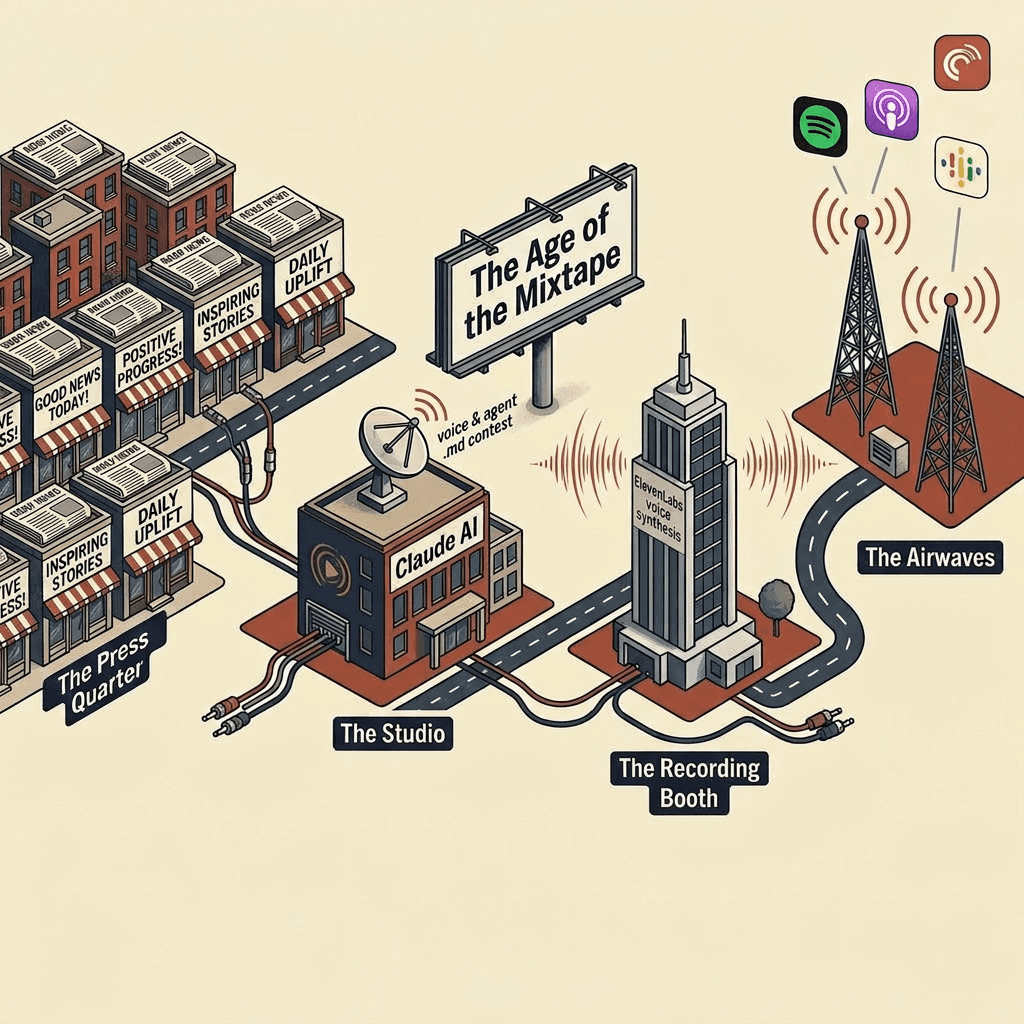
I used Claude Cowork to start off with - I have been testing it alongside Claude Code, which I'm more used to — and it’s really quite impressive. I gave it a prompt describing roughly what I wanted: scrape some RSS feeds, summarise them, push to audio, run it daily. Within fifteen minutes it was up and running locally.
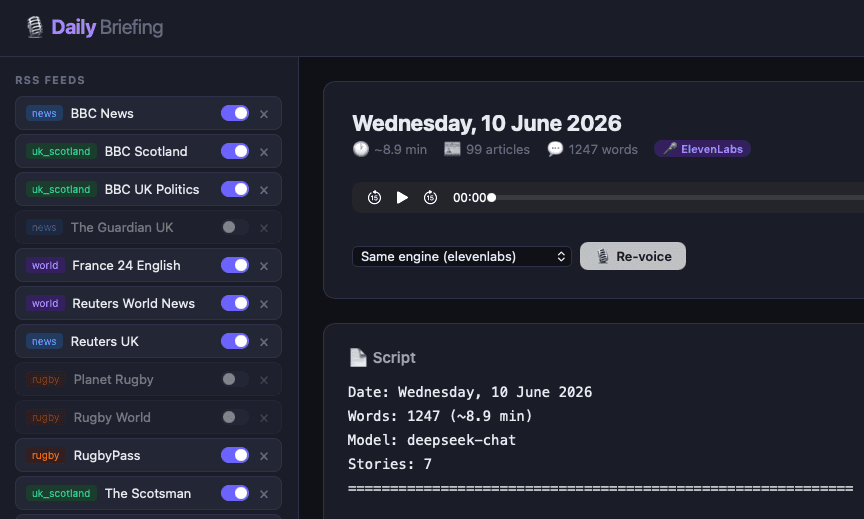
But it had also gone further than my prompt. It had built a configuration interface — something I had not asked for — where I could toggle RSS feeds on and off, adjust how I wanted the summaries structured, and switch between text-to-speech models, from an open source option to ElevenLabs. It had conceived of a complete product rather than just a functional orchestrator.
I then flipped it into Claude Code and ran a security audit first. Then did a manual review, it was good at setting up the product but took some shortcuts for a secure set up, but with enough prods in the right direction caught its errors and set things up perfectly.
From there the conversation was essentially a product roadmap. I wanted it to run automatically every morning. Claude gave me two options — wake the local Mac on a schedule, or deploy to Railway so the machine runs in the cloud by itself. I went with Railway. Five dollar subscription. Then security through Cloudflare so I had proper login restrictions and an OAuth layer with Google. Then an endpoint with a secure hash so I could feed it directly into my podcast app. Then a conversation about cost optimisation, because ElevenLabs is not cheap at scale.
I'll take a quick diversion here into the text-to-speech options. ElevenLabs is just standout in terms of natural flow of voice, perfect for a podcast, Cartesia a close second, then Google's TTS. I set up a model where I use my ElevenLabs subscription first then when I hit a token limit move down to Cartesia and finally Google as a backup. I typically do eight-minute episodes so can hit inside the ElevenLabs subscription most months.
By the end I had a hosted app, a configuration panel, a podcast feed, a private link, and an image for the show.
Now, I want to be honest about the limitations here, because they are real. There were still integration gaps. ElevenLabs needed its own account and API key. Railway needed its own setup. Cloudflare is not complicated but it is still a layer. Each of these is genuinely straightforward just now compared to what it would have been a few years ago — the deployment alone, connecting straight into GitHub with almost no configuration, is something I would have spent a full day on previously — but there is still a non-zero cost to threading them all together. The individual tools are exceptionally powerful. The abstraction layer that collapses all of this into a single workflow does not fully exist yet. I assume it will. These things tend to.
---
Anyway, I love this app and pipeline. I am using it every day just now. If you want to know how to build something similar, ping me. I may publish it at some point, though I am still working out whether that is a good idea.
The mixtape is back. It just sounds a bit different.